Purchase of the looking-glass
The purchase of Coppola's looking-glass is the hinge on which Nathaniel's fate turns. Having just endured a terrifying encounter in which Coppola produced a cascade of eyeglasses that seemed to multiply into a thousand staring eyes, Nathaniel forced himself to recover his calm. Mindful of Clara's words, he admitted to himself that the terrible spook was a figment of his own imagination and that Coppola was an honest craftsman and lens grinder, not Coppelius's cursed doppelgänger. To make amends for his earlier panic, he decided actually to buy something from the pedlar. He reached for a small, very finely crafted pocket looking-glass and, to test it, peered out of the window.
The Looking-Glass and the Revelation of Olympia
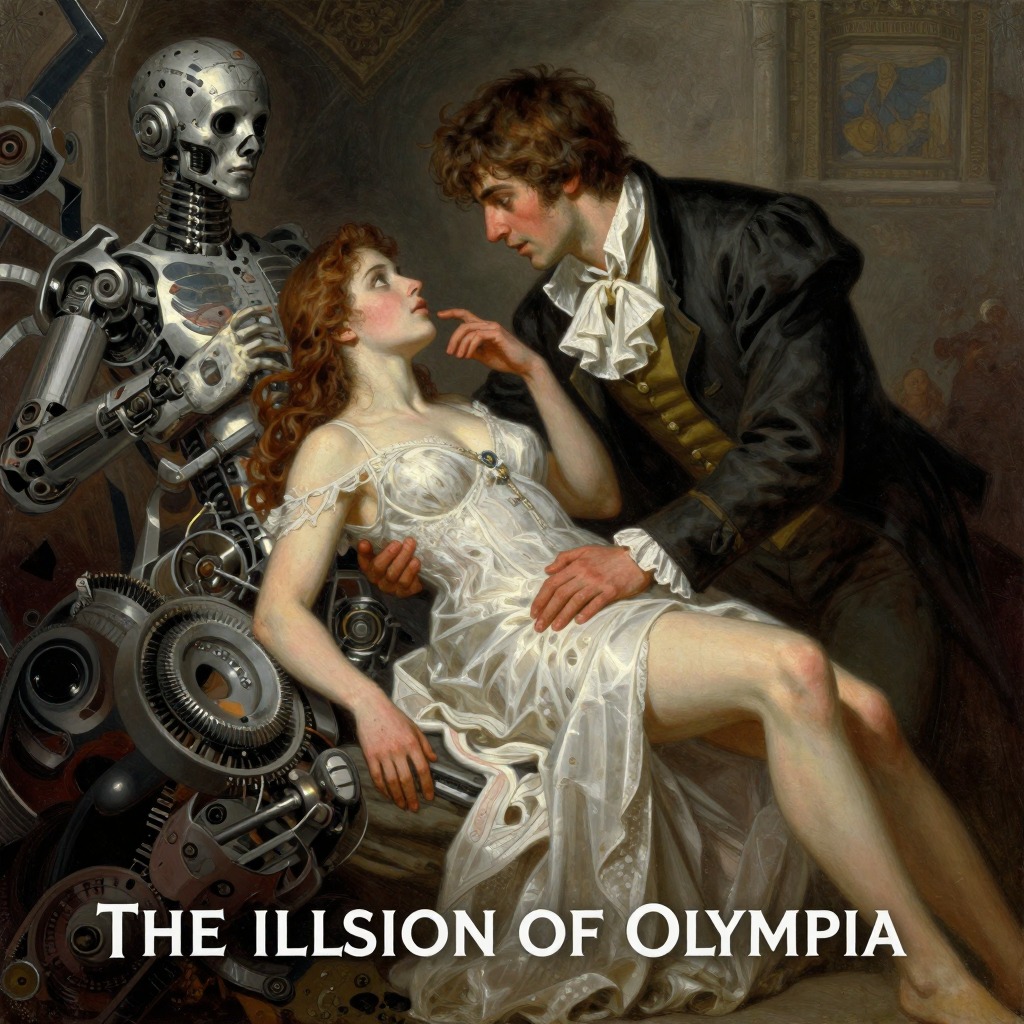
Never in his life had Nathaniel come upon a looking-glass that so clearly and sharply brought distant objects before his eyes in such clear focus. He unintentionally peered into Spalanzani's room, where Olympia sat as usual at her little table, with her arms resting on it and her hands folded. Now for the first time Nathaniel espied Olympia's exquisitely lovely face. Only the eyes appeared strange, blank and dead. But as he brought her face into greater and greater focus in the looking-glass, it seemed to him as if Olympia's eyes flashed open in moist moonbeams. It was as if she had only now acquired the power of sight; her glances grew livelier and livelier. Nathaniel lingered at the window, transfixed, unable to take his eyes off the stunningly lovely Olympia.
The Transaction and Its Aftermath
He was awakened from this trance by the sound of throat-clearing and scraping. Coppola stood behind him and demanded three zecchini—three ducats. Nathaniel, who had completely forgotten the optician, quickly counted out the asking price. Coppola asked with his repulsive hoarse voice and crafty smile whether the glass was fine, and Nathaniel, greatly vexed, replied that it was and bade him farewell. But Coppola cast several strange sidelong looks at Nathaniel and his room before taking his leave, and the young man could still hear him laughing out loud on the staircase. Nathaniel muttered to himself that Coppola was laughing because he had paid far too much for the little looking-glass. As he whispered these words, a deep and terrible deathly groan resounded in the room, so frightening that Nathaniel stopped breathing—but the groan had emanated from his own throat. He told himself that Clara was quite right to take him for a ridiculous ghost-haunted idiot, and that it was perfectly insane to let the thought of overpaying unnerve him to such a degree. Yet a fleeting glance out of the window confirmed that Olympia was still seated there, and driven by an irresistible urge, he jumped up, grabbed Coppola's looking-glass and remained glued to the window, riveted by Olympia's alluring visage, until a friend and fellow student, Siegmund, called out to remind him that it was time to come along to Professor Spalanzani's lecture.
The Looking-Glass as Instrument of Fate
The looking-glass thus becomes the instrument through which Nathaniel's childhood trauma—the threat of having his eyes torn out by Coppelius—is reanimated and redirected. The very object that was meant to restore his rational composure instead delivers him into a new and more devastating obsession. The looking-glass does not merely reveal Olympia; it transforms her, in Nathaniel's perception, from a stiff, stone-cold figure into a living, loving being. From this moment forward, Clara's image is erased from his heart, and he thinks of nothing but Olympia. The looking-glass reappears at the story's climax, when Nathaniel, standing on the town hall tower with Clara, mechanically reaches into his coat pocket, finds Coppola's looking-glass, and turns it sideways—and the sight of Clara through the lens triggers his final, fatal madness. The purchase of the looking-glass is therefore not a casual transaction but the acquisition of a talisman that binds Nathaniel's perception to a fatal illusion, one that ultimately leads him to mistake a wooden doll for a beloved and to hurl himself from the tower to his death.